

“AI Academy for Educational Administrators”
The course is aimed in particular at specialists of the Ministry of Education and Science of Ukraine, employees of educational centers, employees of institutes and state educational institutions.
The training program of the meeting was aimed at increasing the productivity and quality of management decisions in the field of education through the use of artificial intelligence tools.
The training was conducted by leading experts in the field of education and digital technologies:
Iryna SOKOL - computer science teacher of the Sichov Collegium Secondary Educational Service, member of the MES working group on the implementation of AI in secondary education institutions, certified Google for Education trainer; Anastasia SHUPLAT - lecturer at the Department of Pedagogy and Innovative Education of Lviv Polytechnic, Senior Training Program Manager at Beetroot Academy, certified Google for Education educator; Antonina BUKACH - director of the Academy of Digital Development, certified Google for Education trainer; Vasyl ORISHCHUK – Deputy Chairman, Chairman of the Committee on Professional, Specialized Pre-Higher Education, Science and Innovation of the Public Council under the Ministry of Education of Ukraine, co-author of the framework recommendations “Advice on the Responsible Use of AI by Public Servants”, certified Google for Education educator.
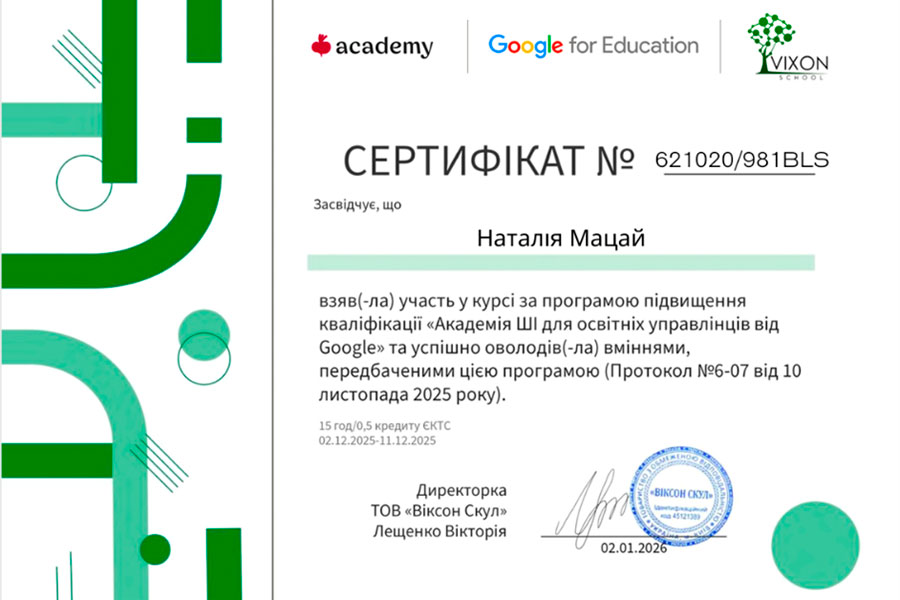
The classes were held in the format of three content blocks: a theoretical module; demonstration of the practical application of AI tools; practical development of skills.
During two weeks, participants learned to create professional management documentation, analyze large amounts of data, and effectively plan work activities using artificial intelligence tools.
Participation in the program was an important step in improving managerial competence and implementing innovative approaches in the activities of the faculty. The knowledge gained will contribute to a more effective organization of the educational process, making strategic decisions using modern digital technologies, and will become a powerful tool for implementing innovative approaches in the management and development of our faculty.
According to the FNAS


